Though a large percentage of Americans appreciated the National Park Service, some viewed it as an overreach of the government’s power that limited their rights. When Yellowstone was established in 1872, scores of people in Wyoming resented that 3,400 square miles of land had been taken away from them, restricting their use for development or logging. Similar opinions arose eighteen years later in Yosemite, where Americans were upset that they could no longer harvest timber, hunt wildlife, or charge tourists for views of the valley. When the Organic Act was ratified, many saw it as a pointless bill that did not compensate them for the lost money they could have had if the system was never created.
U.S. Dept. of the Interior, "NPGallery Search," NPS.
"America's Best Idea"
"[F]or the purpose of relieving the acute condition of widespread distress and unemployment now existing in the United States,... the President is authorized,... to provide for employing citizens of the United States who are unemployed, in the construction, maintenance and carrying on of works of a public nature..."
Unemployment Relief Act of 1933, S. 598, 73d Cong., 1st Sess. (Mar. 31, 1933).
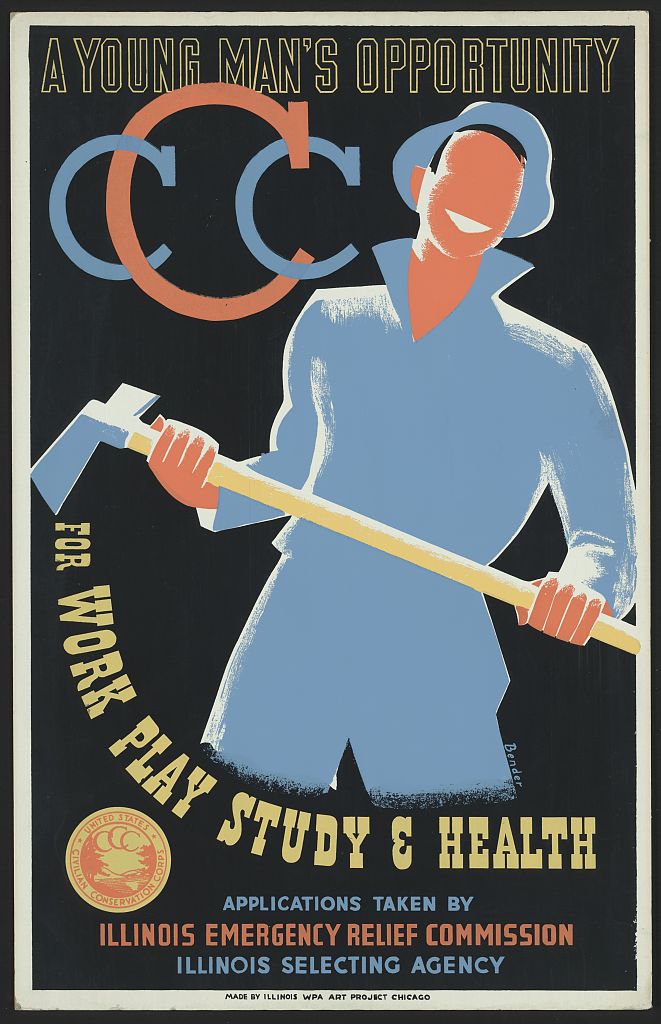
Albert M. Bender, A Young Man's Opportunity for Work, Play, Study & Health, 1941.
However, as time progressed through the twentieth century, the overall opinion of the National Park Service improved, especially during the Great Depression. In an effort to revive the American economy, President Franklin D. Roosevelt created several government programs to provide jobs for citizens, including the Civilian Conservation Corps (CCC) and Works Progress Administration (WPA). These projects, which specialized in conservation, employed countless Americans and skyrocketed the overall quality of the National Parks through the construction of roads, trails, ranger stations, and more. As a result, the National Park Service was no longer seen as an invasive and restrictive installment, but as an institution that provided jobs for Americans and responsibly preserved nature. Over time, most opposition to the system dissolved, and it became a beloved organization that protected and preserved the natural, historical, and cultural heritage of the United States of America.