With the end of the Civil War and the beginning of the Industrial Revolution, Americans continued exploring their uncharted land, seeking economic opportunity. The commercialization at wonders like Niagara Falls saw entrepreneurs build fences and charge tourists to view the landmark through peepholes. Destruction and misuse of land started spreading across the country to locations like Yosemite and Yellowstone, raising concerns about the exploitation of nature.
U.S. Dept. of the Interior, "NPGallery Search," NPS.
"America's Best Idea"
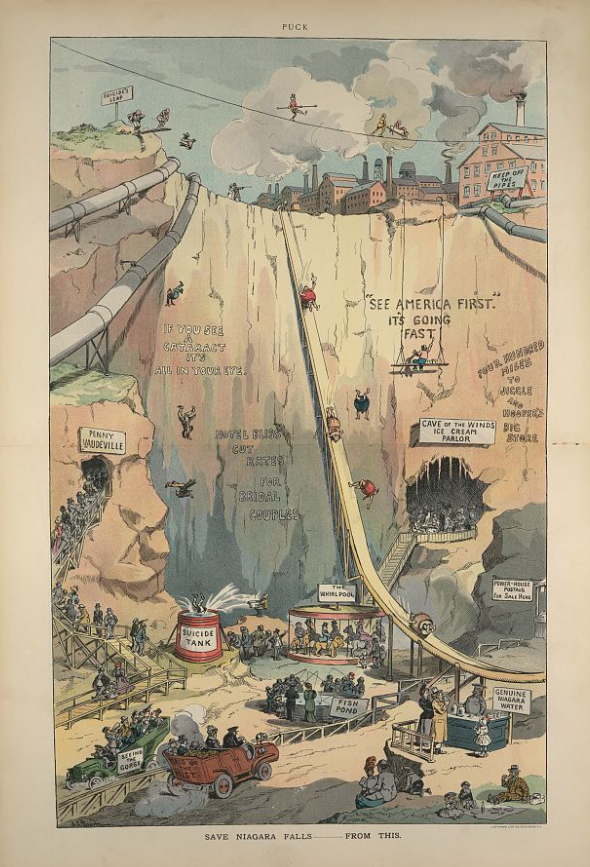
Pughe, "Save Niagara," cartoon, Library of Congress.
"The battle for conservation must go on endlessly. It is part of the universal warfare between right and wrong."
-Wolfe, Son of the Wilderness: The Life of John Muir, 331.
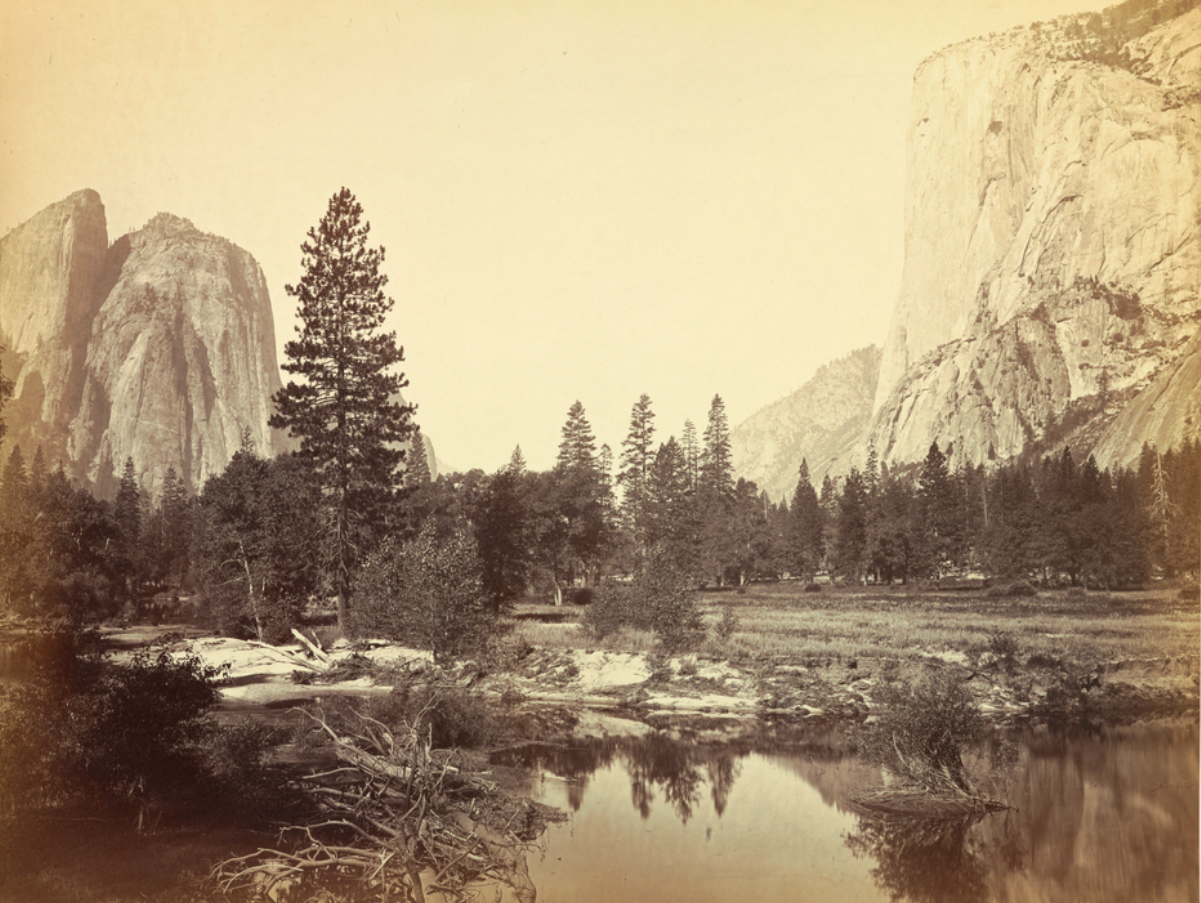
Watkins, Down the Valley.
Artists like John Muir and Carleton Watkins were amazed by America's natural beauty and used their works to awaken conservationist views in their audiences. Their art exhorted Americans to appreciate the nation’s natural beauty and call Congress to protect it. The naturalist movement began paying off in 1864, when the Yosemite Act was signed by President Lincoln, protecting it as a California State Park. In 1872, Yellowstone was established as the world’s first national park, driven by concerns over unregulated tourism and land exploitation, especially with the expansion of the transcontinental railroad.
As the United States entered the twentieth century, conservation efforts intensified, and naturalists wanted more land to be protected for both historical and natural appreciation. However, the growing number of national parks raised new concerns over the management of them without a unifying system...